Republic Day 2026 India: Seven Pillars of Indian Democracy
Republic Day 2026 India marks 76 years of democracy. Explore the Seven Pillars of the Constitution through a cinematic visual story of rights, justice, and people.
CHRONICLES OF BHARAT
What is Republic Day?
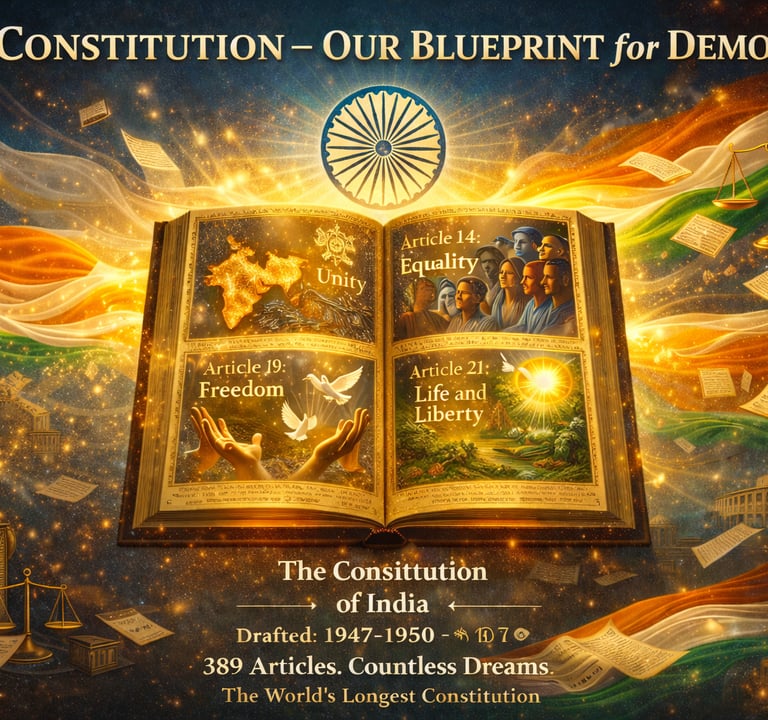
January 26 is Republic Day. On this date in 1950, India adopted its Constitution and became a sovereign democratic republic. It is the day India declared to the world that it would govern itself, that power would rest not in the hands of a few, but in the hands of 1.4 billion people.
Every year on January 26, Indians pause to remember this moment. Not as a historical event alone, but as a living commitment. A renewed promise that the Constitution remains the foundation on which the nation is built.
Republic Day 2026 marks seventy-six years since the Constitution was adopted. Seventy-six years of a democracy learning what it means to protect the rights of 1.4 billion people who speak hundreds of languages, practice multiple religions, come from vastly different economic circumstances, and hold deeply varied worldviews.
The Constitutional Promise: Built on Seven Pillars
January 26 is not simply a date marked on the calendar. It is the moment when a nation declared to the world that it would govern itself. That power would rest not in the hands of a few, but in the hands of 1.4 billion people. That the Constitution would be the living breath of a democracy still learning what it means to be free.
The Constitution did not promise perfection. It promised a framework. A system of principles and institutions designed to protect rights, distribute power, and allow for the peaceful resolution of conflict.
That framework rests on seven fundamental pillars. Each pillar is distinct. Yet they cannot stand alone. Together, they create the democratic structure that makes India, India.
This Republic Day 2026, we tell the story of how a Constitution became a promise, and how that promise continues to reshape lives through these seven pillars that hold the entire democratic structure together.
Pillar One: Sovereignty
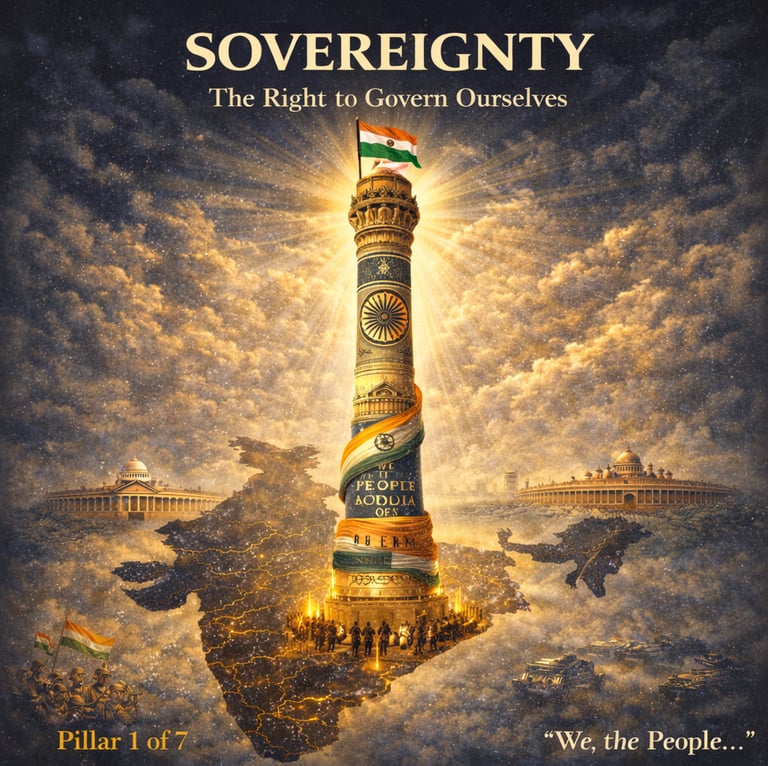
Before anything else, there is sovereignty. The right to self-governance. The recognition that no external power holds dominion over India.
Sovereignty is the foundation pillar because without it, nothing else is possible. It is the assertion that Indians will determine their own destiny. That decisions affecting the nation will be made by Indians, in Indian institutions, guided by Indian law.
The visual language of sovereignty is declaration. It is the moment the Constitution was adopted, the Indian flag unfurled, the nation announcing itself to the world as independent and equal among nations. It is the borders of India drawn by the people who inhabit it. It is the Parliament of India as the supreme legislative body. It is the Indian Armed Forces as the expression of India's will and protection.
Sovereignty is also shown as responsibility. With the freedom to govern oneself comes the burden of ensuring that government serves its people. It is not freedom from all constraints, but freedom within law. Freedom bounded by constitutional limits.
In the visual narrative, sovereignty is portrayed as the ground upon which all other pillars stand. It is the institutional framework that declares: we decide. Not kings, not colonizers, not external powers. We do.
Pillar Two: Liberty
With sovereignty established, the Constitution protects what cannot be taken away: the freedom of every individual to live according to their own conscience.
The Right to Equality means every Indian, regardless of caste, religion, gender, or circumstance, is treated as a full citizen. Not in some distant future. Now.
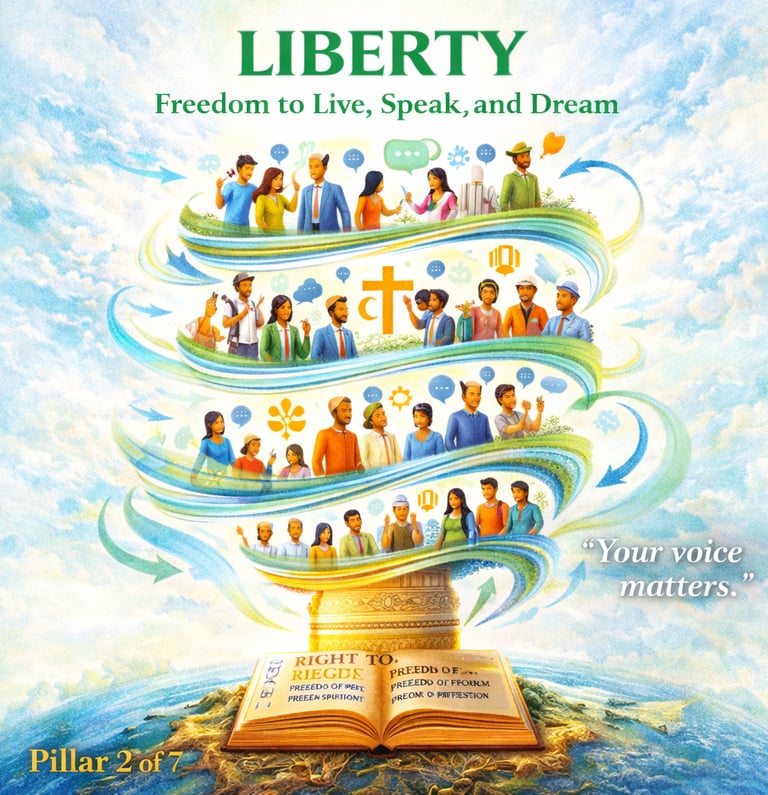
The Right to Freedom means Indians can speak, assemble, move freely. They can practice their beliefs without fear. They can organize, protest, demand accountability.
The Right Against Exploitation protects workers, children, and vulnerable citizens from abuse. The Right to Freedom of Religion allows people to practice faiths of their choice. The Right to Constitutional Remedies means citizens can approach courts when their rights are violated.
The visual language of liberty is movement and diversity. It is people walking freely across borders within the nation, speaking without fear, practicing different faiths in the open, pursuing different professions and dreams. It is the multiplicity of Indian life celebrated and protected by law.
In the visual narrative, liberty is shown not as a gift from authority, but as a right protected by the Constitution. Citizens are portrayed not as subjects seeking permission, but as free people exercising their fundamental rights. The imagery flows—no barriers, only the open space of a liberated people making choices about their own lives.
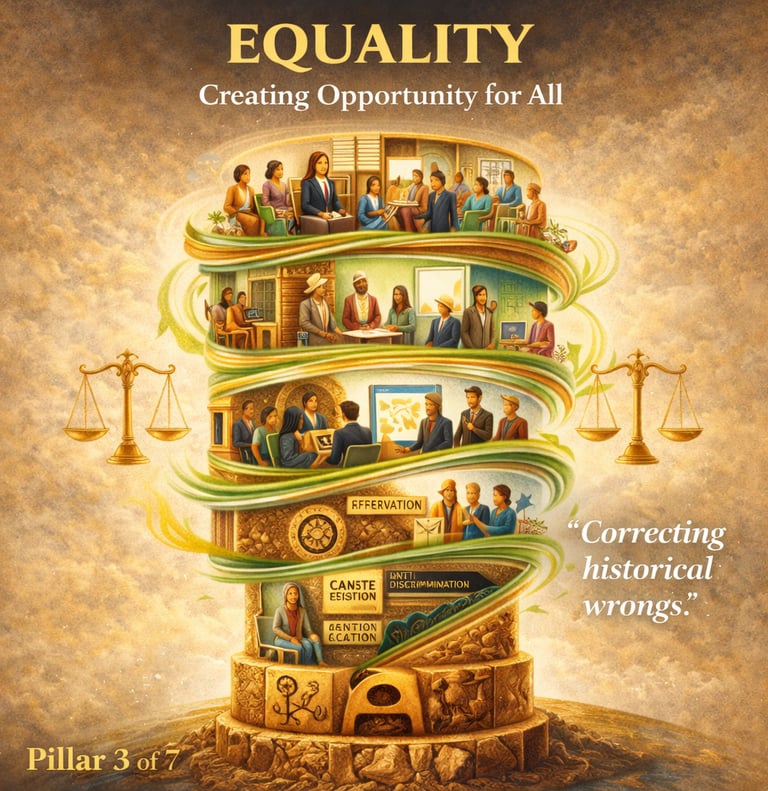
Pillar Three: Equality
But liberty alone is not enough. A person freed from oppression is only truly free if they have equal access to opportunity, to justice, to dignity.
The Constitution outlawed discrimination. It declared that no person could be denied opportunity based on their identity. It established mechanisms for justice. It acknowledged that centuries of exclusion could not be erased by words alone, so it created provisions for affirmative action, for reservations, for deliberate inclusion of those historically excluded.
Equality is not the absence of difference. It is the commitment that differences will not determine access to rights, opportunities, or dignity.
The visual story of equality shows the scale of this commitment. Images of women entering spaces previously denied to them. Images of marginalized communities accessing education, employment, and justice. Images of regional representation in Parliament. Visual language showing: when you expand who has a voice, democracy becomes deeper, not weaker.
The Constitution's approach to equality is shown not as a moment of achievement, but as an ongoing practice. The imagery is forward-moving, building, expanding—because equality is never finished. It is always becoming. It requires institutional commitment, resource allocation, and the constant willingness to correct historical injustices.
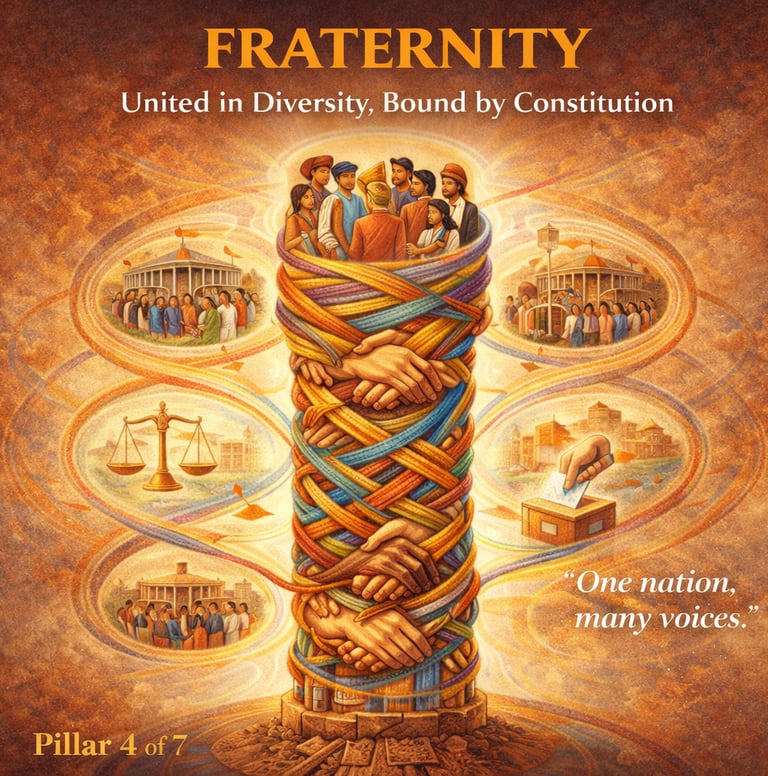
Pillar Four: Fraternity
A Constitution that protects liberty and ensures equality must rest on something deeper still: a sense of shared belonging. A recognition that we are bound together not just by law, but by a commitment to treating each other as family.
The Preamble speaks of fraternity, "assuring the dignity of the individual and the unity and integrity of the nation."
Fraternity in the Indian context is extraordinary. How do you build brotherhood among 1.4 billion people speaking hundreds of languages, practicing multiple religions, holding vastly different worldviews? The Constitution's answer: by creating structures where power is shared, where local voices are heard, where the center acknowledges the legitimacy of the margins.
The visual story of fraternity shows connection. It shows the threads that bind India together. Elections where a farmer in Kerala and a trader in Kashmir cast equal votes. Parliament where speakers of Tamil, Hindi, Marathi, English, and dozens of other languages debate together. Supreme Court judges from different regions interpreting the Constitution for all citizens. Federal systems that respect state autonomy while maintaining national unity.
Fraternity is shown as dialogue. As the difficult, daily work of listening to someone whose life is entirely different from your own and finding common ground. It is the most challenging pillar because it requires choosing to see the other as family, again and again. It acknowledges that unity does not mean uniformity. That diversity can be a source of strength rather than division.
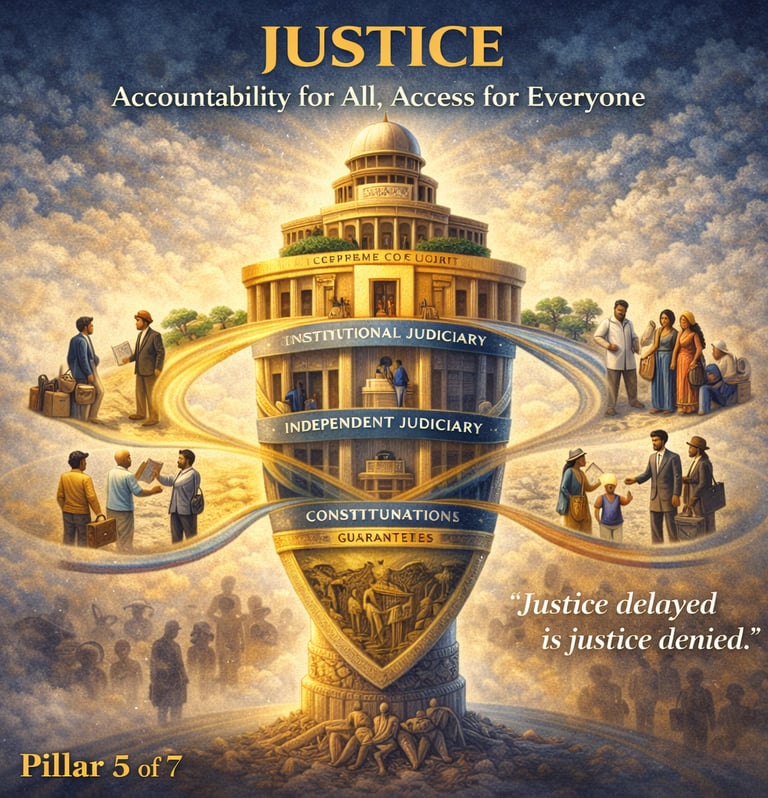
Pillar Five: Justice
The final foundational pillar is justice. Not charity. Not mercy alone. But the systematic, institutional commitment to fairness.
The Indian Constitution created an independent judiciary to protect rights. It established the Supreme Court as the guardian of constitutional values. It created mechanisms for accountability. No power is absolute. Every authority is subject to constitutional scrutiny. Even the government that made the laws must obey the laws.
Justice is administered through courts where the poor can challenge the rich, where citizens can challenge the state, where the marginalized can seek redress. The Constitution guarantees access to justice as a right, not a privilege.
The visual story of justice shows the courtrooms where the powerless can challenge the powerful. It shows the Constitution as a shield protecting citizens from arbitrary state action. It shows the judiciary as the custodian of rights, interpreting the Constitution across generations as circumstances change.
But the visual story also shows the incompleteness of justice. Delayed trials. Overcrowded courts. Inequalities in access. Because the Constitution's promise of justice is not self-executing. It requires investment, will, resources, and continuous recommitment. Justice is portrayed not as achieved, but as struggled for, sought after, and gradually extended across the population.
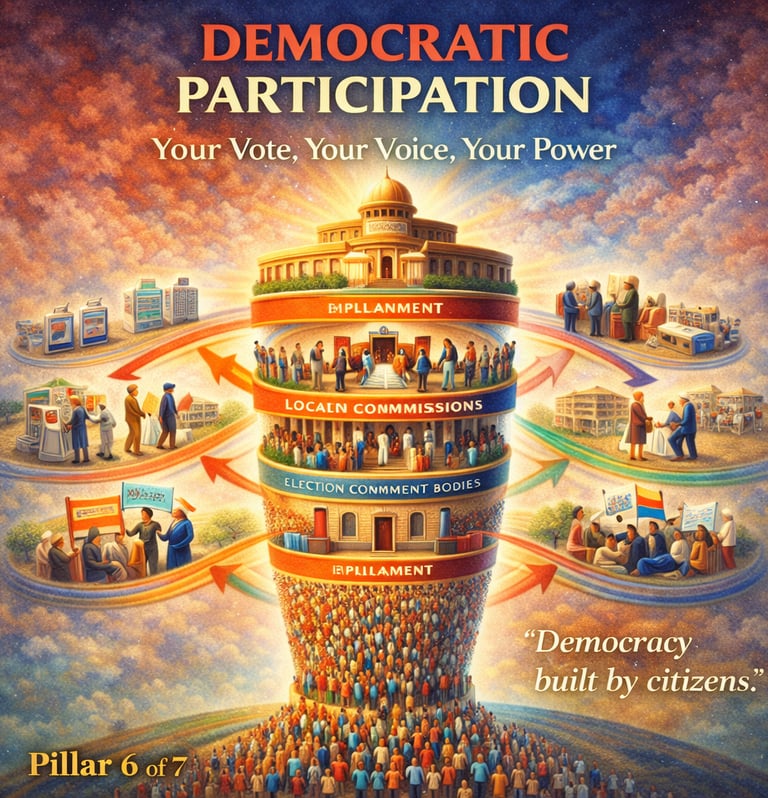
Pillar Six: Democratic Participation
A Constitution is only as strong as the participation of its citizens. Democracy requires that people vote, engage, hold their leaders accountable.
Democratic participation is shown through the machinery of elections. Every five years, 1.4 billion people exercise their right to vote. In the largest democratic exercise on Earth, power is peacefully transferred from one government to another based on the will of the people. This is not guaranteed. It is hard-won and maintained through constant civic engagement.
The visual language of democratic participation includes polling booths, voting machines, election officials, citizens waiting in line to vote. It includes Parliament in session, debates, questioning of ministers. It includes citizens protesting, organizing, demanding change. It includes local government bodies where communities make decisions about their immediate lives.
Democratic participation is also shown as diverse and distributed. Not concentrated in one place or with one group, but happening across the nation, in villages and cities, among farmers and engineers, across age groups and educational backgrounds.
The visual narrative emphasizes that democracy is not automatic. It requires the constant participation of citizens. It requires people caring enough to vote, to stay informed, to engage with the political process. Without this participation, the best constitutional structures become hollow.
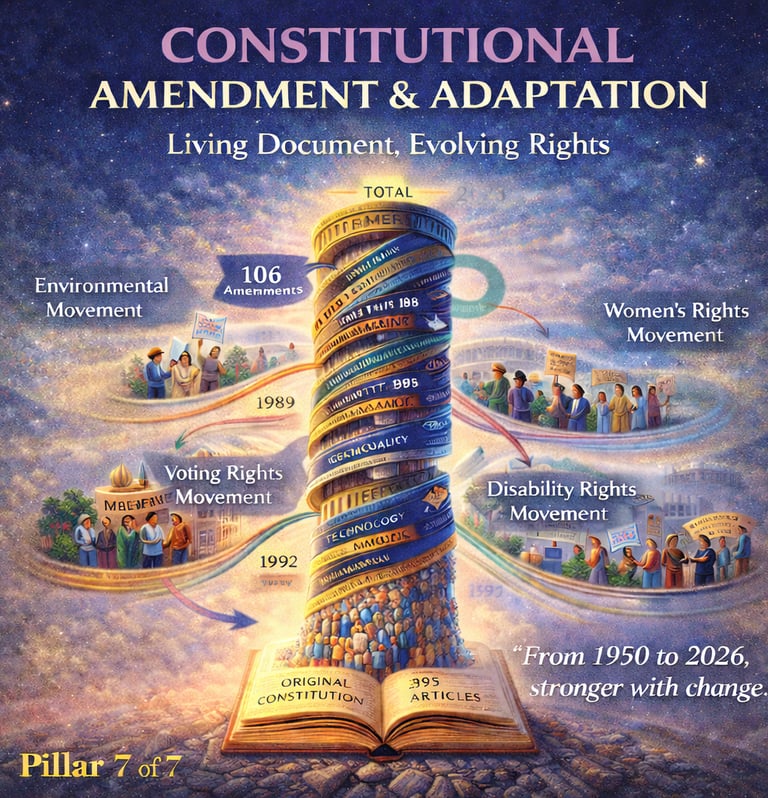
Pillar Seven: Constitutional Amendment and Adaptation
The final pillar is perhaps the most important: the Constitution's capacity to amend and adapt while remaining true to its foundational values.
The Constitution did not emerge perfect from the drafting committee. It was written to be amended, to evolve, to respond to new circumstances while protecting eternal principles.
In seventy-six years, it has been amended 106 times. It has absorbed struggles and corrections. The voting age was lowered to 18. Women's rights were strengthened. Provisions for the disabled were added. Constitutional protections extended to new domains. Federal structures evolved. Electoral systems were refined.
This is not weakness. This is maturity. A constitution that cannot adapt cannot survive. The Indian Constitution's capacity to change while remaining true to its foundational values is itself a form of democracy.
The visual language of this pillar is evolution and responsiveness. It shows the Constitution as a document that grows with the nation. It shows amendments as moments of recommitment. It shows how social movements led to constitutional change. How the Constitution itself became a tool through which marginalized people could fight for dignity and secure new protections.
The visual narrative portrays this pillar as the bridge between past and future. The Constitution is held steady by its core principles, yet flexible enough to extend rights and protections as society evolves, as new challenges emerge, as understanding deepens about what liberty, equality, and justice require.
How the Seven Pillars Hold Together
Each pillar is distinct. Yet they cannot stand alone. Sovereignty without justice becomes tyranny. Liberty without equality becomes privilege for the few. Fraternity without democratic participation becomes forced conformity.
The visual architecture shows how each pillar supports the others. Remove one, and the entire structure becomes unstable. The seven pillars together create a democratic system that is simultaneously strong and flexible, protective of individual rights and committed to collective well-being.
At the center of all seven pillars stands the citizen. The farmer who votes. The student who speaks freely. The woman who enters the workforce. The person from a marginalized community who accesses the courts. The minority whose rights are protected in a majority democracy.
The Constitution begins with words that still echo across seventy-six years: "We, the People of India."
Not the government. Not institutions. Not systems. The people.
Each citizen is both protected by these seven pillars and responsible for maintaining them. The Constitution is not something done to Indians. It is something Indians do, every day, through their participation, their choices, their commitment to democratic values.