Pandu Mahabharata: The Tragic Father of the Pandavas | Mahabharata Life Lessons
Pandu Mahabharata tells the tragic story of the Pandavas’ father—his curse, renunciation, destiny, and the timeless life lessons hidden in his fate.
CULTURAL VISUAL STORYTELLING
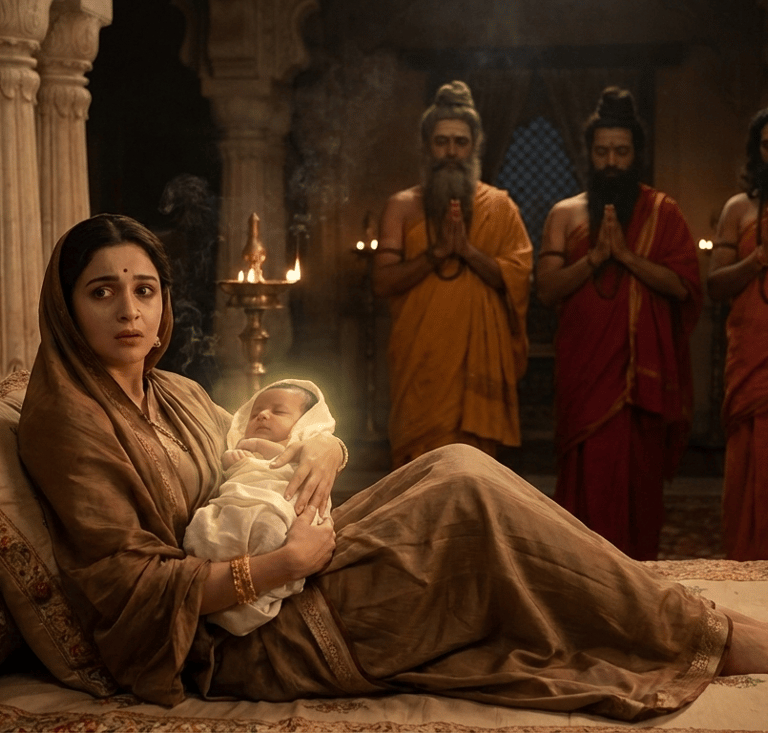
I. BORN FROM FEAR, CHOSEN BY DESTINY
Pandu’s story in the Mahabharata begins not with celebration, but with trembling.
Queen Ambalika, overwhelmed with fear during the sacred niyoga ritual, gave birth to a child touched by her terror.
The newborn’s skin was pale like morning frost, and so he was named Pandu — the pale one.
Astrologers sensed something unusual in the infant’s destiny.
Whispers floated through Hastinapura’s marble corridors:
A king shaped by fear… a warrior shaped by fate.
But Pandu, innocent and unaware, slept peacefully in his mother’s arms — a child already carrying the echo of a future he had not chosen.
Life Lesson
We do not choose the circumstances of our birth, but we carry their shadows.
Fear at the beginning of life does not decide destiny — awareness and action do.
Pandu entered the world through trembling, yet he slept in peace.
Destiny does not burden the innocent — it waits for them to grow.
II. THE GOLDEN PRINCE OF HASTINAPURA
As he grew, Pandu transformed into everything a kingdom could hope for.
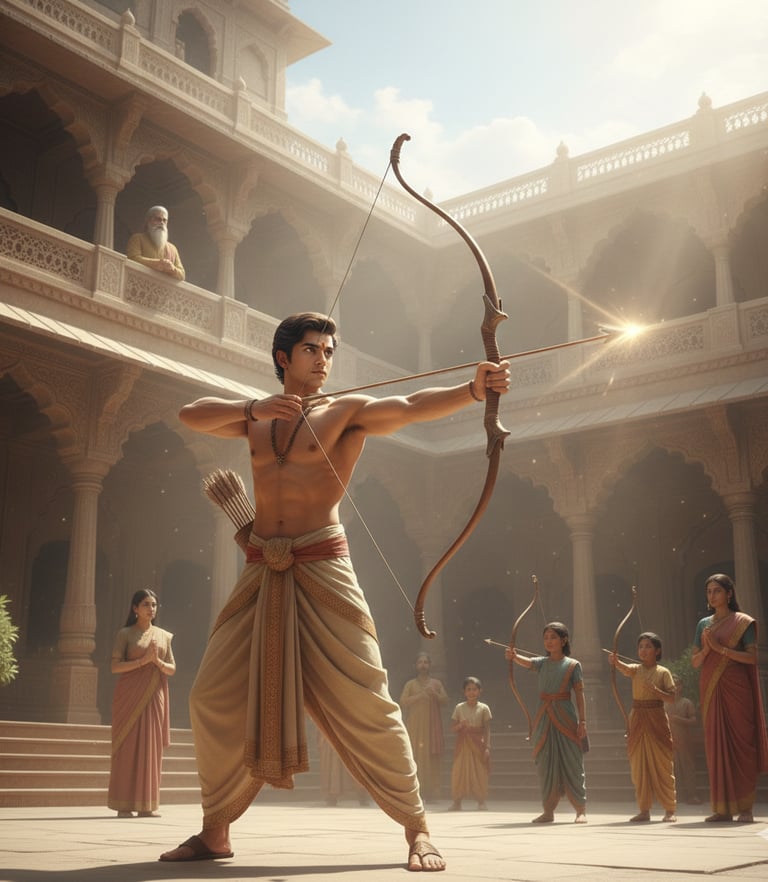
He was graceful with a bow, wise beyond his years, and compassionate in a way that softened even the sternest hearts. Where Dhritarashtra battled his blindness and Vidura fought the prejudice of birth, Pandu walked with effortless charm.
Elders admired him.
People adored him.
Hastinapura trusted him.
Yet behind his composed smile lived a quiet, unspoken restlessness — as though his soul sensed that peace was only a borrowed moment, not a promise.
Life Lesson
Success admired by the world does not silence the restlessness within. Even those who seem complete may sense impermanence before others do.
Pandu had everything — skill, respect, trust — yet his soul knew that peace borrowed is not peace owned.
III. THE CURSE THAT CHANGED A KING
The turning point in Pandu’s life came in a serene forest —
where tragedy often finds those who seek only silence.
While hunting, Pandu released an arrow at what he believed was a deer.
But destiny revealed a harsher truth:
he had struck Sage Kindama, who had taken the form of a deer with his wife.
In his final breath, the sage spoke words that would shatter Pandu’s world:
“As you have killed me in the moment of love,
so shall death claim you the moment desire rises within you.”
The forest watched as a king crumbled.
The curse seeped into Pandu’s heart like a slow poison,
turning every touch into a threat,
every longing into fear.
Life Lesson
A single unexamined action can alter an entire life.
Intent does not erase consequence.
Pandu did not seek cruelty — yet fate answered carelessness with permanence.
Wisdom lies not only in strength, but in restraint.
IV. THE KING WHO WALKED AWAY FROM HIS CROWN
A cursed king is a prisoner even in a palace.
Pandu returned to Hastinapura, but the throne felt heavier than any weapon he had ever carried.
How could he rule a kingdom when he could not even trust his own heart?
How could he embrace his wives when affection itself was fatal?
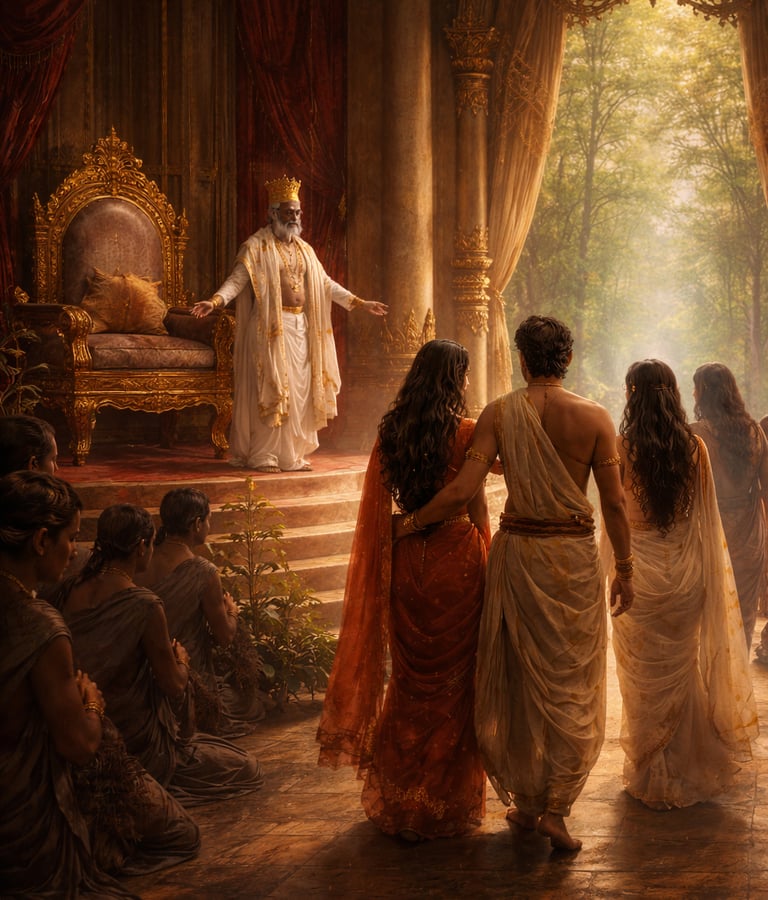
With quiet dignity, he renounced his crown.
He placed the kingdom into Dhritarashtra’s hands and walked into the forest —
not out of weakness,
but out of profound responsibility.
Kunti and Madri, bound to him by devotion deeper than fear, chose exile over comfort.
The forest became their refuge, their prison, and their fragile peace.
Life Lesson
True responsibility sometimes means walking away from power.
Renunciation is not weakness — it is moral courage.
Pandu chose conscience over comfort, silence over sovereignty.
Not every crown deserves to be worn.
V. SONS BORN OF PRAYER AND DESTINY
In the heart of the forest, Pandu’s life found a fragile glow.
Kunti revealed her divine mantra — a sacred gift allowing her to invoke gods and bear children through celestial grace.
And so, the Pandavas were born:
Yudhishthira, son of Dharma — calm, wise, unshakeable.
Bhima, son of Vayu — powerful, unrestrained, loyal.
Arjuna, son of Indra — destined for greatness and divine warfare.
Nakula and Sahadeva, sons of the Ashwini twins — radiant, skilled, and gentle.
Each child illuminated Pandu’s world like a festival of light.
He held them with trembling joy, overwhelmed by love so fierce it almost hurt.
But with every birth, the curse whispered softly:
“You can be a father, but never again a husband.”
Life Lesson
True responsibility sometimes means walking away from power.
Renunciation is not weakness — it is moral courage.
Pandu chose conscience over comfort, silence over sovereignty.
Not every crown deserves to be worn.
VI. THE SILENT BATTLE WITHIN
Pandu’s real war was not with kingdoms —
but with himself.
He lived surrounded by love he could not fully receive.
He watched his sons grow strong,
watched Kunti guide them with steady warmth,
watched Madri weave laughter into their quiet life.
But he remained a man who could not cross the barrier fate had built around him.
Some nights, he stared at the stars and asked:
“What is a king without a kingdom?
What is a husband who cannot reach for his wife?
What is a man whose touch can bring death?”
The forest held his sorrow gently,
but offered no answer.
Life Lesson
The deepest wars are fought in silence.
To live surrounded by love yet unable to fully receive it is a quiet suffering few understand.
Pandu did not lack family —
he lacked permission from fate to belong fully.
VII. THE SPRING THAT BROKE HIS HEART
Spring arrived with its intoxicating fragrance, stirring memories Pandu had buried for years.
One morning, Madri stood bathed in golden sunlight, her hair flowing like a river of darkness against the soft breeze.
Her beauty, her innocence, her devotion —
all of it pulled at the loneliness in Pandu’s soul.
A longing rose in him like a storm.
For a heartbeat, he forgot the curse.
For a heartbeat, he reached out as a man yearning for warmth.
And fate claimed him instantly.
Pandu collapsed into Madri’s arms, his life extinguished by the very desire he had spent years fleeing.
The forest fell silent, as though mourning a soul that had suffered too much.
Life Lesson
Suppressed longing does not disappear — it waits.
Even discipline has limits when loneliness grows too deep.
Pandu fell not because he forgot the curse —
but because he was human.
Madri refused to live after him.
She stepped into the flames of his funeral pyre, whispering that her soul belonged nowhere else but beside him.
Kunti, now alone with five young sons, carried a grief far deeper than words.
She held her children close, knowing their father’s legacy was not power —
but love carved from suffering.
Pandu left the world as he had lived in it —
a man caught between destiny and desire,
a king who sought peace but found pain,
a father whose children would one day shape the fate of Bharat.
His story is not one of failure,
but of humanity — raw, fragile, and achingly real.