Gandhari Mahabharata: The Blindfolded Queen's Untold Story
Discover the complete Gandhari Mahabharata visual story — the blindfolded queen who chose darkness for love, warned a son who wouldn't listen, cursed Krishna in grief, and found peace only in the forest. Life lessons from the Mahabharata's most misunderstood woman.
CULTURAL VISUAL STORYTELLING


I. THE PRINCESS OF GANDHARA
Born to King Subala in the prosperous kingdom of Gandhara, Gandhari was no ordinary princess. She was brilliant, deeply learned in the Vedas, and raised with the discipline of a warrior and the devotion of a saint. Her beauty was matched only by her intellect — a woman forged equally by knowledge and grace.
She had received a boon from Lord Shiva himself — the gift of a hundred sons. A blessing so rare, so powerful, that it marked her as destined for greatness before she had even chosen her path.
In a world where a woman's worth was measured by her husband's throne, Gandhari carried something far rarer — a sense of self that no palace could give her and no arrangement could take away.
Life Lesson: True strength begins before the world tests you. The values you build in silence become the foundation you stand on when everything shakes.
II. THE BLINDFOLD — A CHOICE THAT DEFINED EVERYTHING
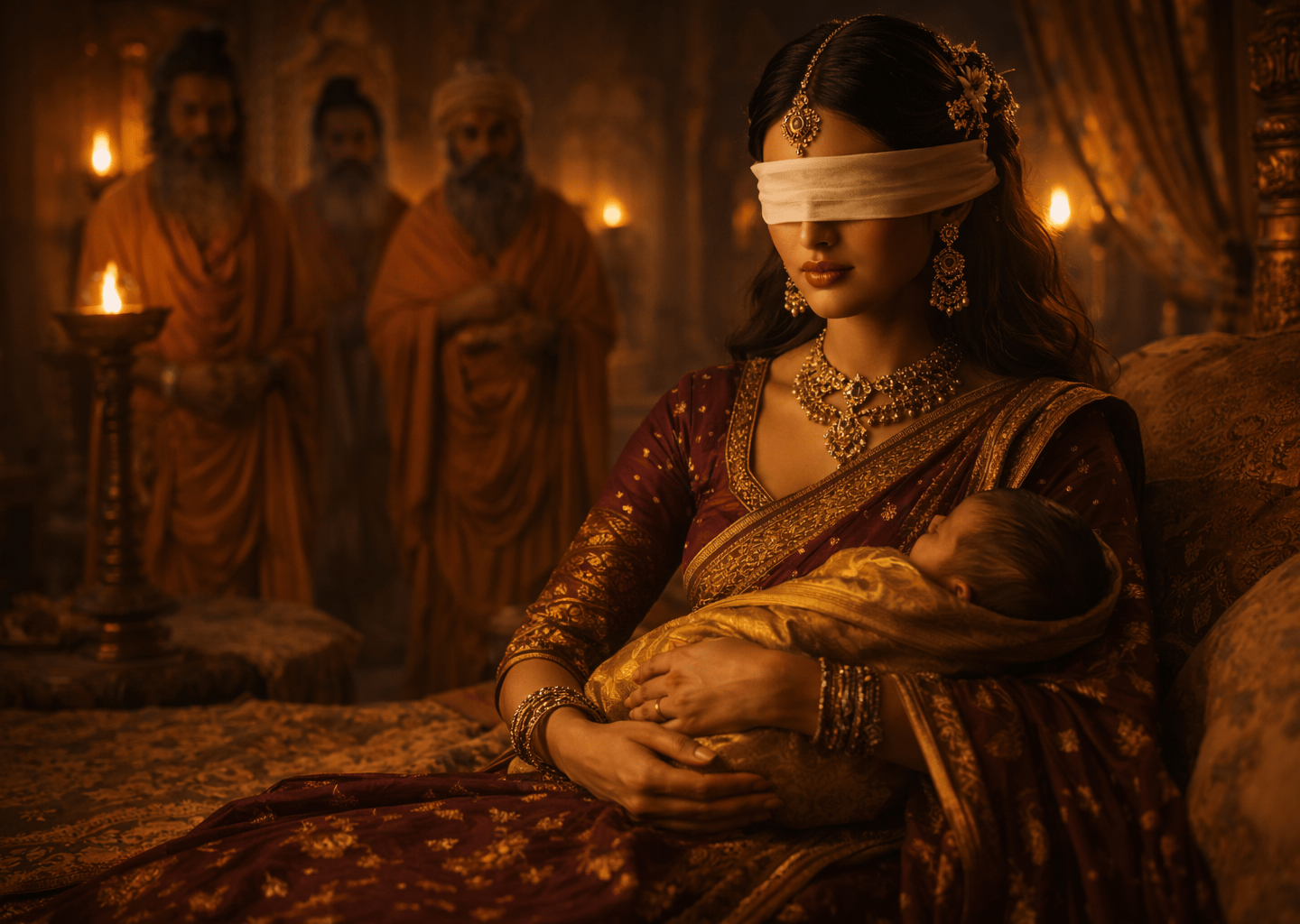
When Gandhari learned she was to marry Dhritarashtra — a king born blind — she made a decision that stunned every royal court in Aryavarta.
She tied a blindfold over her own eyes.
Not because she was commanded to. Not because tradition demanded it. But because she refused to possess a gift her husband could never share. If he could not see the world, neither would she.
This was not weakness. This was the most radical act of equality the age had ever witnessed — a queen surrendering her sight as a declaration of solidarity, not submission.
She would wear that blindfold for the rest of her life. Through war. Through loss. Through the death of a hundred sons. Never once removing it. Never once regretting it.
Life Lesson: The sacrifices we make from love rather than obligation become our greatest source of inner power. Choose your commitments consciously — then honour them completely.
III. QUEEN OF HASTINAPURA
Gandhari arrived in Hastinapura not as a victim of circumstance but as a queen who had already defined her own terms.
She bore her blindfold with such dignity that the court, which had initially whispered in pity, fell into quiet reverence. She learned every corridor by memory, every voice by tone, every political current by instinct. What she lost in sight she gained tenfold in perception.
She became Dhritarashtra's true counsel — the voice of restraint behind a king whose love for his son Duryodhana would eventually blind him far more completely than his physical eyes ever could.
Gandhari saw everything. She simply could not always make those around her listen.
Life Lesson: Perception is not limited to the eyes. When you quiet one sense, others sharpen. True wisdom comes from listening more deeply than the world expects.
IV. THE HUNDRED SONS — AND THE WARNING UNHEARD
Gandhari's pregnancy lasted an extraordinarily long time. When the moment of birth finally came, what emerged was not a child but a hard mass of flesh — a sign, many sages warned, of terrible ill omen.
Sage Vyasa intervened, dividing the mass into a hundred portions, and from those portions came a hundred sons — and one daughter, Dushala.
Duryodhana, the firstborn, arrived accompanied by omens so dark that the court astrologers urged Dhritarashtra to abandon the child. Gandhari heard the warnings. She understood what they meant.
But she was a mother first.
She chose love over prophecy — and in doing so, unwittingly set the first stone of the Kurukshetra war into place. Not from malice. From the most human instinct that exists.
Life Lesson: Love without boundaries can sometimes become the seed of destruction. Even the purest devotion must be tempered with the courage to choose what is right over what feels impossible to refuse.
V. THE MOTHER BEHIND THE THRONE
As Duryodhana grew — proud, ambitious, and increasingly consumed by hatred for the Pandavas — Gandhari never stopped counseling restraint.
She warned him. Repeatedly. Clearly. Without softening the truth.
She told him that adharma would destroy him. She told him that his hatred for his cousins would cost him everything. She told him the Pandavas carried dharma on their side, and that no army — however vast — could defeat dharma on a battlefield.
Duryodhana did not listen.
History often remembers Gandhari as the mother of the villain. What history forgets is that she was also the only one in his life who consistently told him the truth — and was consistently ignored.
Life Lesson: Speaking truth to those we love, even when they refuse to hear it, is still the right thing to do. Our responsibility is to counsel wisely — not to control outcomes. The rest belongs to the choices others make.
V. THE MOTHER BEHIND THE THRONE
As Duryodhana grew — proud, ambitious, and increasingly consumed by hatred for the Pandavas — Gandhari never stopped counseling restraint.
She warned him. Repeatedly. Clearly. Without softening the truth.
She told him that adharma would destroy him. She told him that his hatred for his cousins would cost him everything. She told him the Pandavas carried dharma on their side, and that no army — however vast — could defeat dharma on a battlefield.
Duryodhana did not listen.
History often remembers Gandhari as the mother of the villain. What history forgets is that she was also the only one in his life who consistently told him the truth — and was consistently ignored.
Life Lesson: Speaking truth to those we love, even when they refuse to hear it, is still the right thing to do. Our responsibility is to counsel wisely — not to control outcomes. The rest belongs to the choices others make.
VII. EIGHTEEN DAYS OF SILENCE
For eighteen days, Gandhari sat in the royal pavilion and listened to a war she could not stop.
She heard the conches. She heard the war cries. She heard the earth shake beneath charging elephants and the screams of dying men. She heard the names of her sons fall, one by one, from the lips of messengers who could barely speak.
Every report was a wound. Every silence between reports was its own particular agony.
She did not weep publicly. She did not collapse. She sat with a stillness so complete it frightened those around her.
Inside, she was being unmade.
Life Lesson: Endurance in grief is its own form of courage. When we cannot act, the only power left is how we choose to bear what is unbearable. Stillness in devastation is not weakness — it is the deepest strength.
IX. THE FOREST AND THE FINAL FREEDOM
After the war, Gandhari chose the forest.
She walked away from Hastinapura — the palace where she had arrived as a bride, raised a hundred sons, counseled kings, and buried everything she loved. She left with Dhritarashtra, Kunti, and Vidura, seeking the peace that no throne room had ever offered.
In the forest, stripped of every role — queen, mother, wife, counselor — she found something she had not felt in decades.
Herself.
She meditated. She prayed. She sat in the stillness that had always been inside her, waiting beneath the decades of duty and grief and endurance.
She died in a forest fire, alongside Dhritarashtra and Kunti. The Mahabharata records it not as tragedy but as transcendence — three souls departing together, released at last from the weight of history.
Life Lesson: The final act of a fully lived life is letting go. When we have fulfilled every duty, loved every person we were given to love, and spoken every truth we were given to speak — peace is not just possible. It is earned.
GANDHARI'S ETERNAL LEGACY
Gandhari is not the villain's mother. She is the woman who chose integrity in a world that rewarded convenience, who spoke truth in a court that celebrated flattery, who sacrificed sight to honor solidarity, and who bore a grief so vast it moved even God to silence.
Her story belongs to every woman who was right and unheard. Every mother who counseled wisely and watched helplessly. Every person who endured the consequences of others' choices with their dignity intact.
"To choose darkness willingly in service of love is not blindness — it is the clearest vision of all."







VI. THE EVE OF KURUKSHETRA
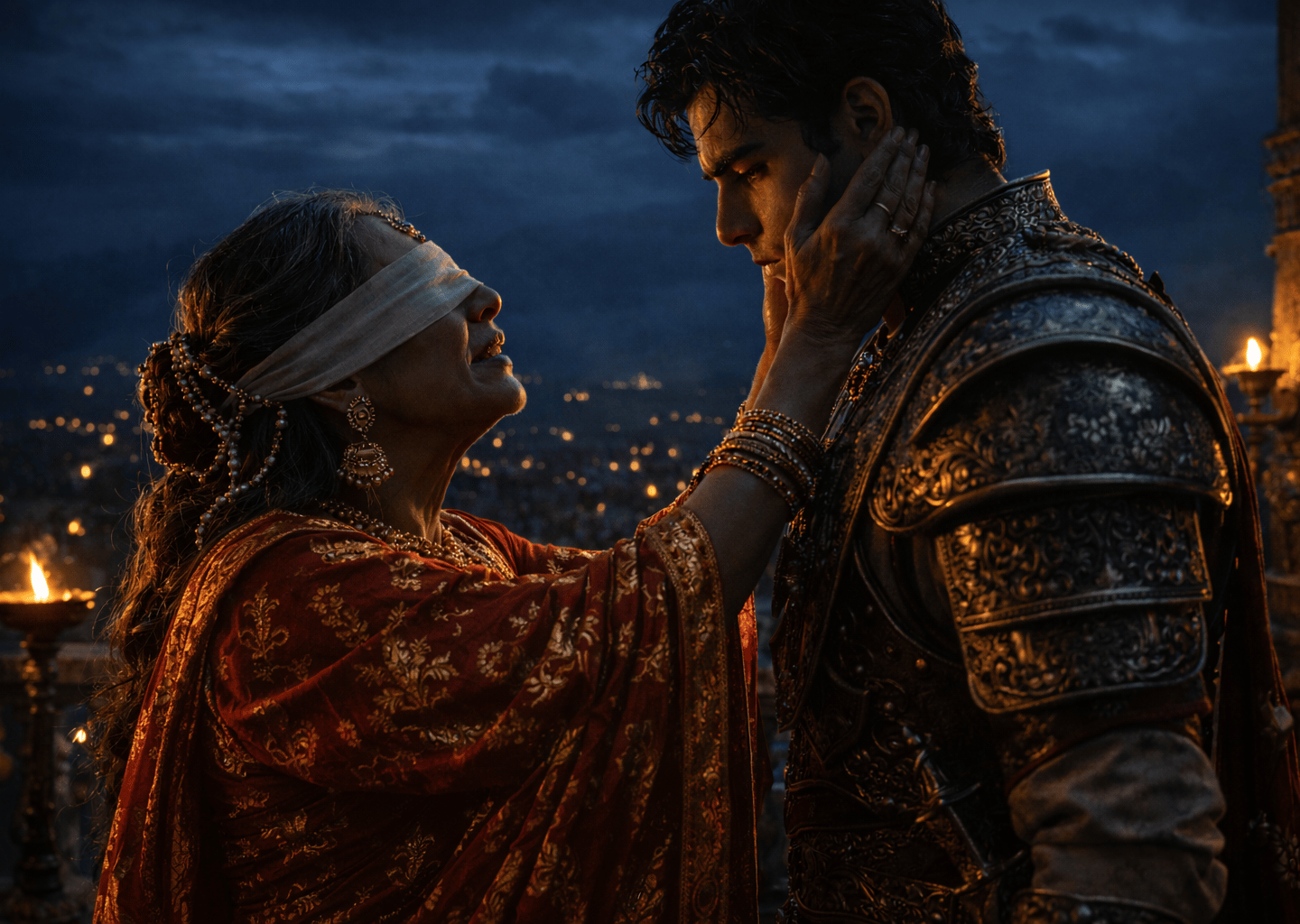
On the night before the greatest war the world had ever known, Gandhari made one final attempt.
She summoned Duryodhana. She held his face in her hands — those hands that had never seen him, yet knew every feature of him by touch. She told him there was still time. She told him peace was still possible. She told him that the blood of a hundred sons was not a price worth paying for a throne.
He embraced her. He touched her feet. And he walked to war anyway.
Gandhari then did something extraordinary. She opened her blindfold — just slightly — and cast her gaze upon Duryodhana's body, infusing his skin with the power of her lifelong penance, making him nearly invincible.
But Duryodhana had bathed without covering himself completely, leaving one area vulnerable.
It was enough. It would cost him everything.
Life Lesson: Even our greatest gifts cannot save those who have already chosen their path. We can offer protection, wisdom, and love — but we cannot carry another person's destiny for them.



VIII. THE CURSE THAT SHOOK KRISHNA
When the war ended and Gandhari stood amid the bodies of her hundred sons, something in her finally broke — not her dignity, but her restraint.
She confronted Krishna.
She told him he had the power to stop this war. That he had chosen not to. That the deaths of her sons, the Pandavas' nephews, the thousands of warriors — all of it could have been prevented.
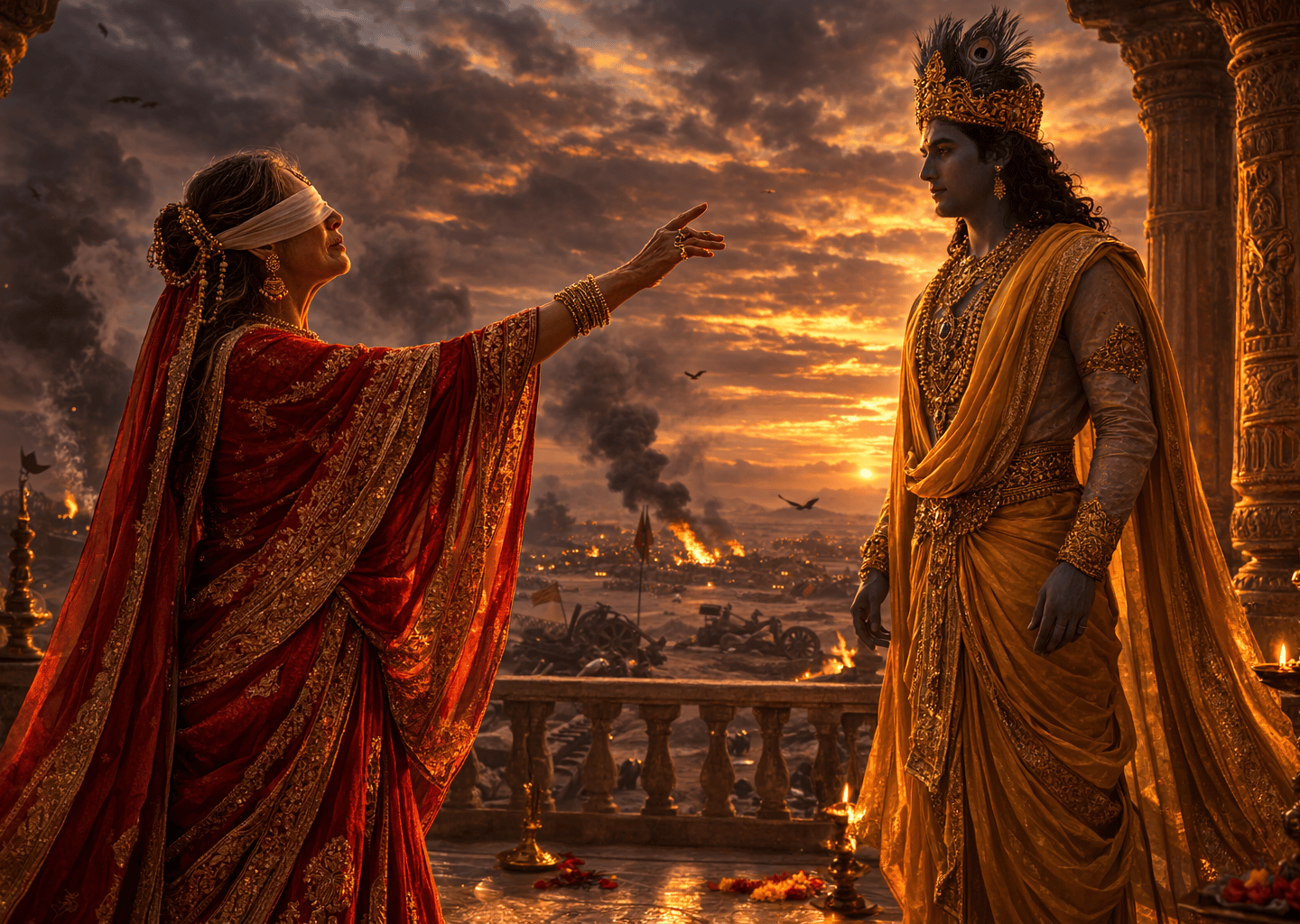
And then Gandhari — a woman of lifelong penance, whose spiritual power had accumulated across decades of sacrifice — cursed Krishna himself.
She declared that just as her sons had killed each other, Krishna's own clan, the Yadavas, would destroy themselves. That he would die alone, unattended, in a forest.
Krishna accepted the curse without protest. He told her she was right.
Even God, it seems, did not argue with Gandhari's grief.
Life Lesson: There are moments when even the most disciplined among us reaches the end of endurance. Grief, when it is just, carries its own authority. But every curse we give the world also lives within us — so release your pain, and then release the curse itself.